

SURGING ELECTRICITY COSTS: WHY RENEWABLES ARE ESSENTIAL FOR MINES
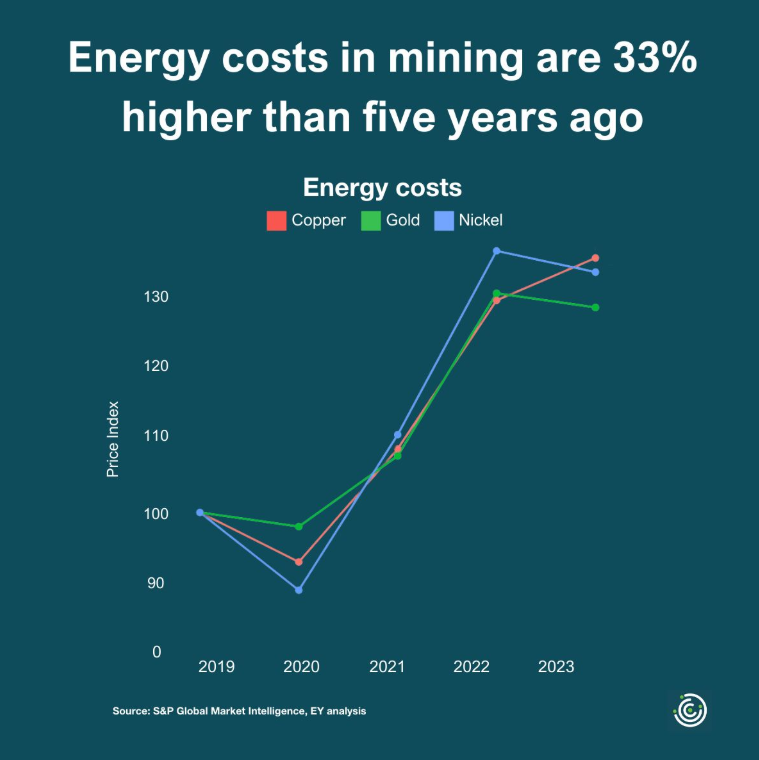 Over the past several years, the mining industry has experienced a dramatic rise in electricity costs, straining operational budgets and putting long-term profitability at risk. This upward trend—driven by fuel price volatility, increased regulatory pressures, and growing demand for sustainable mineral extraction—has forced mining companies to seek innovative solutions.
The numbers speak for themselves. A recent review of the mining sector by AgTech company Farmonaut observes, “Mining is notoriously energy-intensive. As global en1.%09https:/farmonaut.com/mining/mining-energy-efficiency-boost-efficiency-cut-costs-2025ergy prices remain vo1.%09https:/farmonaut.com/mining/mining-energy-efficiency-boost-efficiency-cut-costs-2025latile and emissions caps are enforced, the sector must find ways to boost efficiency without compromising output or worker safety.”
PwC’s Mine 2025 global mining report likewise notes that despite surging mineral demand, “higher costs and rising investment are eating into the top 40 global mining companies’ profits,” and that “EBITDA margins shrank to 22% fromhttps:/www.pwc.com/gx/en/industries/energy-utilities-resources/publications/mine.html 24% in 2023, largely due to increased operating expenses and utilities.”
Most acute off grid
Traditionally reliant on diesel generators—where the delivered cost of energy routinely reaches $150–200/MWh—mining companies with remote or off-grid operations have become acutely aware of their vulnerability to market fluctuations and diesel price spikes. Farmonaut notes that automation and process electrification, trends that promise operational efficiencies, can paradoxically add to electricity demand and exposure to rate risk.
Enter renewables for mines
The case for renewables in mining is no longer just about decarbonization goals or ESG ratings. It’s now central to long-term cost control. As an article from Australian mining investment website Discovery Alert observes, “Hybrid renewable systems in remote, arid mining locations reduce the reliance on diesel by 40-60%. This transformation not only enhances sustainability but also significantly cuts running costs.” The article notes that battery energy storage systems (BESS), solar microgrids, and wind farms have quickly evolved into mainstream options, citing real-world examples:
- Gold Fields’ Granny Smith mine, which deploys an 8MW solar array paired with a 2MW/1MWh BESS, has eliminated millions of litres of diesel use and achieved reliability on par with conventional power. “Their system’s 98.5% uptime matches that of conventional power sources.”
- Rio Tinto’s Amrun Project, where a 12.4MW solar farm has reduced annual diesel consumption by 37%, equivalent to about $4.4 million in fuel savings. “Levelized cost of energy from solar installations now ranges between $30–50/MWh … in stark contrast to diesel generation.”
Farmonaut found that from an operational perspective, “deploying energy efficient mining electrical systems is among the most impactful strategies for optimizing mining energy efficiency. In 2025, modern mines increasingly incorporate high-efficiency motors, variable frequency drives … and smart electrical grids that integrate on-site renewable energy with the main grid. This hybrid approach enables mines to optimize power supply and respond to grid demands efficiently, while cutting emissions.”
Addressing the reliability question
A persistent challenge—both real and perceived—has been the intermittent nature of wind and solar photovoltaic (PV) generation. Critics frequently claim that these sources are “unreliable,” particularly given the continuous, energy-intensive requirements of mineral processing and ore movement.
However, according to a 2025 study published in Applied Energy, “the reliability of renewable sources has significantly improved, making them more viable for remote mining operations where grid connectivity is a challenge” The research details how advances in hybrid systems, battery storage, and even emerging hydrogen power are transforming intermittency into a manageable—and often minor—factor. “Hybrid systems combine renewable sources with energy storage to provide more reliable power.”
Discovery Alert notes that energy management systems now enable seamless switching between sources and storage, achieving “98.5% uptime” at commercial-scale installations like Granny Smith. Data-driven optimization further ensures power quality and continuity that meet or exceed historical diesel generator benchmarks.
A business imperative for mining
The trajectory is clear: mining companies that invest early in renewables reap competitive value not only from direct energy cost savings but also from reduced emissions penalties, improved ESG ratings, and access to capital from sustainability-focused investors. Speaking to Farmonaut, one sector specialist concludes, “The mining sector’s transition to renewable energy isn’t solely about environmental responsibility. It is quickly becoming a business imperative, driven by investor demands, regulatory pressures, and operational economics.”
Read more.
ROUND-THE-CLOCK CLEAN HEAT AND POWER
WITH NO ADDITIONAL CAPITAL COST
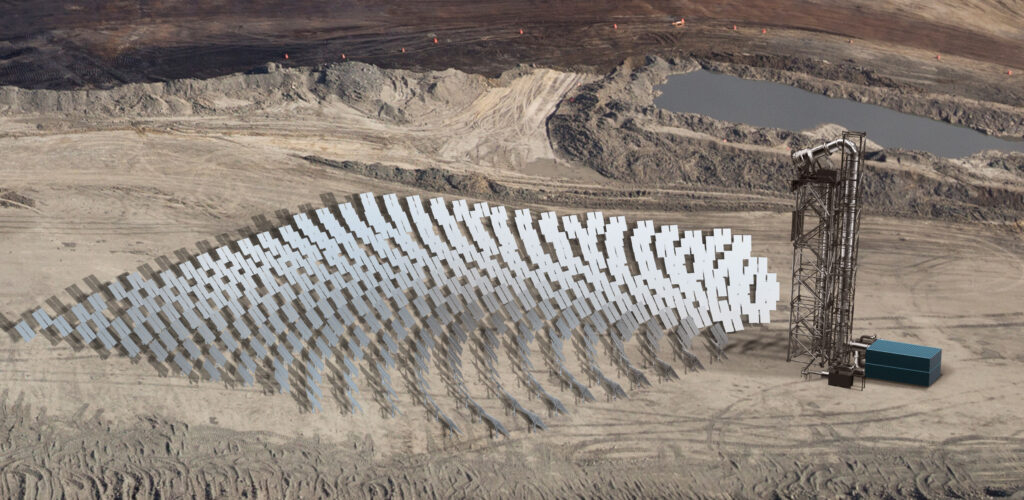
247Solar builds, owns and operates our hybrid solutions and sells round-the-clock clean heat and power on a PPA basis. Mines pay only for the energy they use with no additional capital cost and no risk.
We remove the burden of ownership by assuming all responsibility for operations, maintenance, insurance and repair. We guarantee energy delivery – redundant systems ensure reliability and eliminate the need for gensets.
Here’s what that means for miners:
- Reduced energy costs by 25% or more
- Stable, predictable energy prices for decades
- Lower operating costs per ton
- Increased competitiveness
- Longer life-of-mine
Get in touch to learn more
U.S. FIRM TO PROVIDE RARE EARTHS FOR EV MOTORS
Credit: Energy Fuels
Mining.com reports that Colorado-based Energy Fuels (NYSE-A: UUUU) (TSX: EFR) has signed a memorandum of understanding with South Korea’s POSCO to supply high-purity neodymium-praseodymium (NdPr) oxides for the manufacturing of rare earth permanent magnets.
POSCO is a global leader in the manufacturing of traction motor cores used in EVs and hybrids, and the largest supplier in South Korea. Per the MOU, POSCO intends to process NdPr oxides supplied by Energy Fuels into metal, alloy and finished magnets for use in its traction motor cores.
In a press release, Energy Fuels confirmed that the NdPr oxides have passed all quality assurance and quality control benchmarks for EV drive unit motors to be sold to major automotive manufacturers across North America, the EU, Japan and South Korea.
US-produced rare earths
According to mining.com, The NdPr oxides are produced at Energy Fuels’ White Mesa mill in Utah. In addition to producing neodymium and praseodymium, which are considered “light” rare earths, the White Mesa mill is also piloting the production of the more in-demand “heavy” rare earths, starting with dysprosium — also a key ingredient in permanent magnets.
In light of China’s recent announcement of expanded and tightened restrictions on rare earth exports, the successful production of rare earth permanent magnets from Energy Fuels’ NdPr oxides would represent a major step toward building a “mine-to-magnet” supply chain independent of China.
The press release quotes Mark Chalmers, CEO of Energy Fuels saying, “We are excited to announce that rare earth oxides mined, processed and produced in America are expected to be powering EVs and hybrids for sale around the world very soon … We plan to construct ‘heavy’ rare earth oxide capacity in 2026 at our White Mesa mill in Utah, thereby ‘closing the loop’ on this important non-China supply chain.”
Read more.
ZIMBABWE URGES MINES TO BUILD OWN POWER STATIONS
Lidia Daskalova/Shutterstock
ZESA Holdings, Zimbabwe’s national power utility, is urging mining companies to invest in their own power generation facilities. As reported in Energy and Power Insider, electricity consumption in Zimbabwe is surging, with growth in demand being driven by new and expanding mines as well as an increasing number of households connecting to the grid.
At the same time, the country is experiencing electricity shortages due to various factors, including low water levels at the Kariba South hydroelectric plant and equipment challenges at the Hwange Power Station. According to EPI, reduced water allocations from the Zambezi River Authority due to regional drought conditions are further straining the country’s power generation capacity.
ZESA Holdings has also encountered funding issues for the maintenance of its aging generation and distribution infrastructure.
This has led ZESA to moves like a tariff agreement with Dinson Holdings, a company developing an iron and steel plant near Mvuma. Under this agreement, Dinson Holdings will construct three renewable energy plants with a combined capacity of 270MW to power its operations, in exchange for subsidised electricity from ZESA.
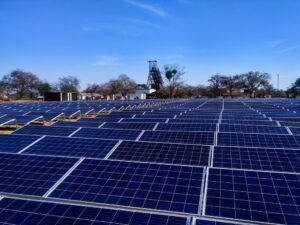
EPI cites other examples where mining companies like Caledonia Mining and Golden Valley Mine are proactively investing in solar power plants to supplement their energy requirements. Caledonia Mining has already completed a 12MW solar plant at its Blanket Mine in Gwanda, while Golden Valley Mine is in the process of constructing a 7MW solar facility at its gold mine in Kadoma
By self-generating their own power, mines can both insulate their operations from power challenges and relieve a burden on the grid as it struggles to ensure reliable electricity supply for industrial, commercial, and residential consumers alike.
Read more.
FOLLOW & JOIN 247Solar
LinkedIn US, LinkedinEU, Twitter, YouTube
Contact: info@247solar.com