

IEA: CLEAN ENERGY INVESTMENT EXCEEDS FOSSIL SPEND
iStock
Clean energy investment is accelerating across the globe despite significant regional disparities and an uncertain geopolitical and policy environment. According to the IEA’s recent World Energy Investment report, investment in clean energy sectors is on pace to double the amount invested in fossil fuels for the first time.
Released in June, the report projects that in 2025, total global energy investment will reach $3.3 trillion—a 2% real increase over 2024. Clean energy sectors (including renewables, nuclear, grids, storage, low-emission fuels, efficiency, and electrification) will collectively receive about $2.2 trillion, twice the $1.1 trillion allocated to oil, natural gas, and coal. The authors believe this represents a pivotal shift, as capital flows steadily prioritize energy transition technologies over traditional fossil fuel supply.
Favorable trends
Among the report’s findings for the clean energy sector:
- Investment in electricity (generation, grids, storage) is set to reach $1.5 trillion—50% higher than total fossil fuel supply spending. This reversal from a decade ago illustrates what the authors describe as the onset of an “Age of Electricity,” driven by industrial demand, electric mobility, AI, and data center growth.
- Low-emissions power generation spending has nearly doubled over five years, with solar the standout leader. Global solar investment (utility and rooftop) will reach $450 billion, making it the largest single energy investment item.
- Nuclear investment has rebounded 50% over five years, exceeding $70 billion.
- However, grid investment, vital for integrating renewables, lags at $400 billion per year versus $1 trillion in generation—struggling to keep pace with electricity demand due to permitting delays and grid material supply chain constraints.
- Demand-side investment (electrification and efficiency) is projected at $800 billion, nearly double decade-ago levels, propelled by EV sales and industrial electrification.
Meanwhile:
- Upstream oil investment is expected to fall 6% (the steepest decline since 2016), reflecting subdued price and demand expectations. Total upstream oil and gas investment is projected just under $570 billion (down 4%), with 40% for production-maintenance spending.
- Global coal plant approvals and coal supply investment (up 4%) continue to surge in China and India to keep up with demand, but no new advanced-economy coal turbine orders occurred for the first time ever.
- Spending on LNG infrastructure is expected to rise sharply, especially in the US, Qatar, and Canada, where new projects will soon drive record annual capacity expansions.
Regional disparities
Though these trends are encouraging on the surface, clean energy investment remains concentrated in a handful of markets (China, EU, US). Other regions, especially in Africa and parts of Southeast Asia, lag due to high capital costs, limited public and private finance, and heightened investor risk perceptions—jeopardizing global net-zero ambition. Africa, in particular, faces a sharp finance gap, with 2025 investment a third below 2015 levels. High debt costs and a meager 2% share of global clean energy investments hamper progress despite supporting 20% of global population.
Still not enough
Despite increased investment, the report’s authors note that current flows fall short of what’s required for net zero. Closing the gap, they say, will demand a tripling of annual clean energy funding by 2030, to nearly $6 trillion, and a much steeper ratio of low-carbon to fossil fuel investment.
They note that governments offering clear, stable net-zero policies—like those in the UK, China, and India—are attracting the lion’s share of transition capital. These policy environments reduce investment risk and spur businesses to scale climate solutions, making markets more resilient and competitive.
At the same time, markets with fluctuating or unclear net-zero legislation (notably the US, recently) are seeing wavering investor confidence and project cancellations or delays, which may slow the roll-out of new clean technology manufacturing and infrastructure—even as initial momentum remains strong.
Access the full IEA report here.
ROUND-THE-CLOCK CLEAN CLEAN ELECTRICITY AND HEAT
400kWe 247Solar Plants deployed at scale
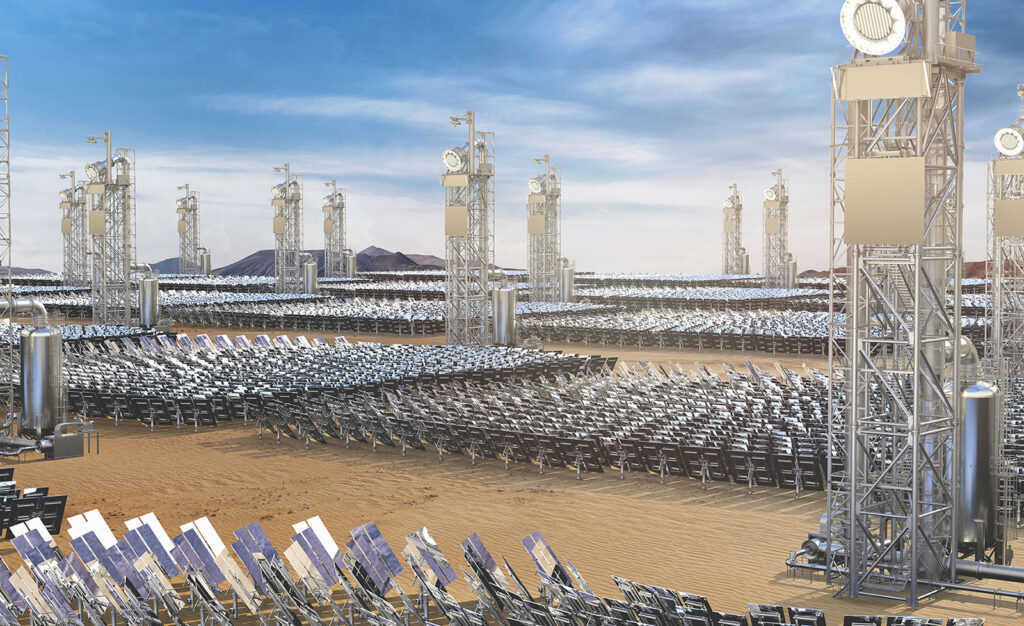
247Solar Plants™ bridge the gap between conventional wind and solar and the need for round-the-clock utility power and industrial-grade heat. 247Solar Plants store the sun’s energy as heat instead of electricity, for 18 hours or more, at much less than the cost of batteries. No generators are required, and 247Solar’s turbines can also burn a variety of fuels, including hydrogen, to ensure 24/7/365 dispatchability.
Extensive Applications
On-grid or off-grid, 247Solar Plants offer a 24/7 alternative to fossil fuels for a broad range of applications:
- CHP: 24/7 low-carbon Combined Heat & Power for industry
- Ultra Heat: Each 247Solar Plant can provide up to 1,500,000 Btu/hr. of heat at temperatures up 1000℃/1800℉ for industrial processes such as cement, glass, steel making, or minerals processing
- Microgrids: Always-on, emissions-free electricity and heat for islands, mines, communities, facilities
- 24/7 baseload power: 24/7 solar electricity, especially for emerging economies
- Green Hydrogen: 24/7 solar electricity and heat to power electrolysis around the clock
- Green Desalination: 24/7 solar electricity and heat to purify water around the clock
AUSTRALIAN INDUSTRY CRAVES RENEWABLES

South Australia has one of the most advanced electricity networks in the world, and Australian industries are clamoring to connect.
Giles Parkinson writes in RenewEconomy that Australia’s biggest energy consumers are lining up to plug in to what he says is “the country’s – and arguably the world’s – most advanced renewable grid.”
According to ElectraNet, the transmission company that provides the backbone of the state’s grid, “more than three dozen companies … have made inquiries about setting up major business in the state and connecting into the state grid, with the specific requirement to source zero emissions and low cost wind and solar.”
Parkinson writes, “[T]he country’s biggest energy consumers, the huge aluminium smelters and refineries, such as Rio Tinto’s Gladstone assets, have made it very clear that without wind and solar, their business has no future beyond the end of the decade. Coal and gas are too costly, and too dirty.”
Far from resisting renewables out of concern for reliability, industries across sectors — miners, green steel companies, data centres and others — are swamping the grid with demand. ElectraNet says the combined incremental load of these industries amounts to astonishing 15 gigawatts, more than 10 times the current average load in the state, and five times the maximum demand.
This experience is similar to that of Western Australia, which hosts the biggest isolated grid in the world. Its demand forecasts – again focused on new industry seeking low cost and zero emissions wind and solar – would require some 50 gigawatts of new renewable and storage capacity over the coming decades.
According to Parkinson, the grid in South Australia has achieved a 74 per cent share of wind and solar over the past year and is on track to meet its target of 100 per cent net renewables by the end of 2027. ElectraNet says the SA grid regularly achieves “100% instantaneous variable renewable energy, driven by its world-leading uptake of grid scale renewable energy resources and rooftop solar PV.”
Read more here.
SOUTH AFRICA TO PROMOTE GREEN HYDROGEN AS SPRINGBOARD FOR DEVELOPMENT
Creamer Media
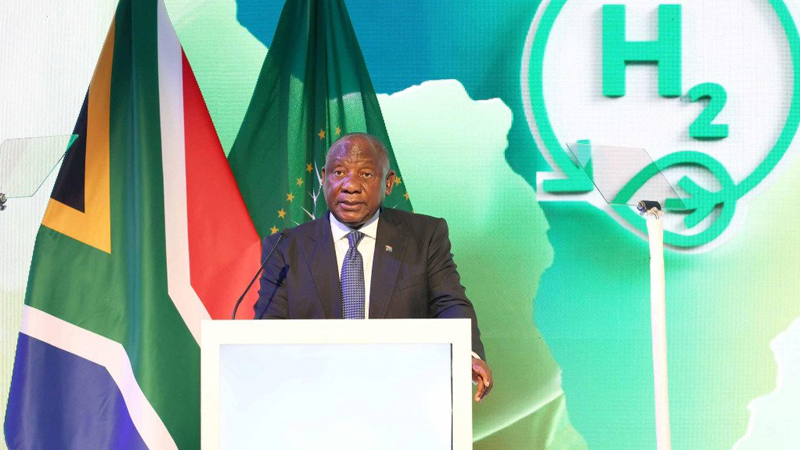
Speaking at the Africa Green Hydrogen Summit in Cape Town in June, South African President Cyril Ramaphosa committed to using South Africa’s G20 Presidency to promote green hydrogen as an anchor for industrial transformation and infrastructure investment, as well as a bridge to a new export industry for African countries.
As reported by Mining Weekly, Ramaphosa noted that the potential of green hydrogen “could be realised only if prevailing impediments to the growth of the industry were addressed,” and he called for a shift from ideas to commitments.
In that context, he lauded the German government’s decision to include a specific allocation for Africa in its second H2Global auction, which was launched earlier this year.
Per Mining Weekly, the auction comprises five lots and includes a budget of at least €484-million apiece for four regional projects in Africa, Asia, North America, and South America and/or Oceania. Suppliers bidding in the regional lots are allowed to offer renewable hydrogen, ammonia, or methanol, all of which must be delivered to a designated hub in Germany from 2028.
The African lot, Ramaphosa said, would guarantee offtake for successful projects on the continent.
Read more.
FOLLOW & JOIN 247Solar
Contact: info@247solar.com