

RENEWABLES OFFER COST AND SPEED ADVANTAGES FOR DATA CENTERS
Rocky Mountain Institute
The explosive growth of data centers worldwide is compelling utilities and policymakers to balance reliability, affordability, and decarbonization in the face of rapidly changing demand patterns. Amid concerns about power shortages, the prevailing narrative often exaggerates the challenges posed by these facilities, A report from the Rocky Mountain Institute reveals that smart integration of renewables—particularly solar, wind, and battery storage—offers a clear path to resilient, affordable, and sustainable data center expansion.
A realistic look at demand
Data centers—critical hubs powering everything from cloud storage to AI—currently account for about 2% of global electricity demand and are projected to represent approximately 10% of electricity demand growth between 2024 and 2030. While media headlines frequently depict this expansion as “explosive and out of control,” the reality is more measured. Historically, forecasts have regularly overstated the impact. RMI notes that, “Globally, the share of electricity going to data centers has remained under 2 percent, and cryptocurrency today consumes just 0.5 percent of global electricity.”
The local impacts, however, are real. Concentration of hyperscale data centers in power-cheap regions can create notable spikes in load, challenging region-specific supply resilience and rates. In the U.S., this uncertainty is prompting utilities to build new generation—often fossil-based. Yet RMI found that “utilities over-forecast 10-year demand growth by more than 17 percent between 2006 and 2023,” resulting in billions spent on excess power plants and unnecessary ratepayer costs.
Overlooked risks of preferred approaches
Natural gas is often favored for its dispatchability and speed, but RMI’s analysis reveals major drawbacks in cost and risk. Planned gas capacity in U.S. utility resource plans jumped 20 percent (52 GW) in the past year, a response to speculative data center load that may never fully materialize. RMI cautions that if data center demand underperforms, ratepayers will be left paying for unused plants and volatile fuel costs.
Nuclear—especially small modular reactors (SMRs) and restarts—has attracted data center interest. Although SMRs promise shorter construction timelines than traditional nuclear, industry experience shows consistent cost and schedule overruns.
Geothermal’s scalability remains limited and price reduction is needed before widespread adoption is viable. As RMI cautions, “For these technologies to be commercially competitive, they will need to come down significantly in price.”
Data centers exploring carbon capture-equipped natural gas find themselves confronting operating complexity and high costs. “Carbon capture, use, and storage (CCUS) technologies considerably increase capital and operational costs and may also face challenges becoming an economically competitive option,” RMI writes.
Renewables: Fast, Flexible, Cost-Effective
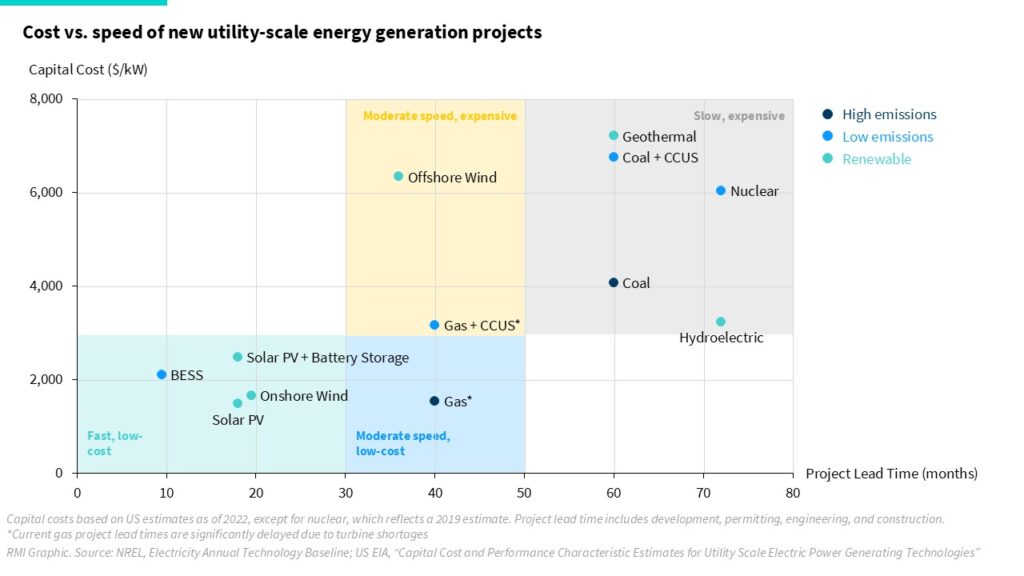
Among supply-side technologies, renewables stand out as the fastest and most affordable new additions to the grid. RMI emphasizes that “solar and onshore wind, combined with battery storage, is the cheapest and fastest source, with a typical project lead time of less than two years. In comparison, natural gas plants take three to four years—a timeline that is now being set back even further due to turbine shortages.”
Solar and wind projects are also effective at keeping consumer electricity rates low, since they avoid exposing customers to fossil fuel price shocks. Colocation of data centers with renewable generation—either adjacent to new or existing wind/solar farms—enables direct integration and synergy, allowing data centers to absorb curtailed or surplus renewable output and thereby relieve grid stress while maintaining reliability.
Procurement via green tariffs and power purchase agreements (PPAs) helps operators achieve “100 percent renewable energy on an annual basis,” with tariffs allowing both utilities and data centers to manage investment and rate risks as new infrastructure is built out.
When combined with battery or thermal storage, especially in grid-interactive systems, renewables can add needed flexibility by providing spinning reserves, peak shaving, and backup for grid interruptions. Together with modular deployment approaches, these technologies create the basis for a responsive, demand-driven grid, where capacity is right-sized to confirmed loads instead of speculative forecasts.
Data Centers as Partners for a Clean, Robust Grid
The report concludes that rather than viewing data centers solely as a burden, utilities and policymakers should leverage their capital, flexibility, and appetite for innovation to drive “no-regrets” grid upgrades. As RMI puts it, “when data centers are seen as a burden on the electricity system, it makes utilities more prone to hasty decisions like overbuilding new natural gas capacity.”
By harnessing the advantages of renewables and advanced storage, the sector can manage peak demand, minimize stranded asset risks, and chart a path forward that fulfills reliability and affordability objectives while advancing the clean energy transition.
Read more here.
ROUND-THE-CLOCK CLEAN CLEAN ELECTRICITY AND HEAT
400kWe 247Solar Plants deployed at scale
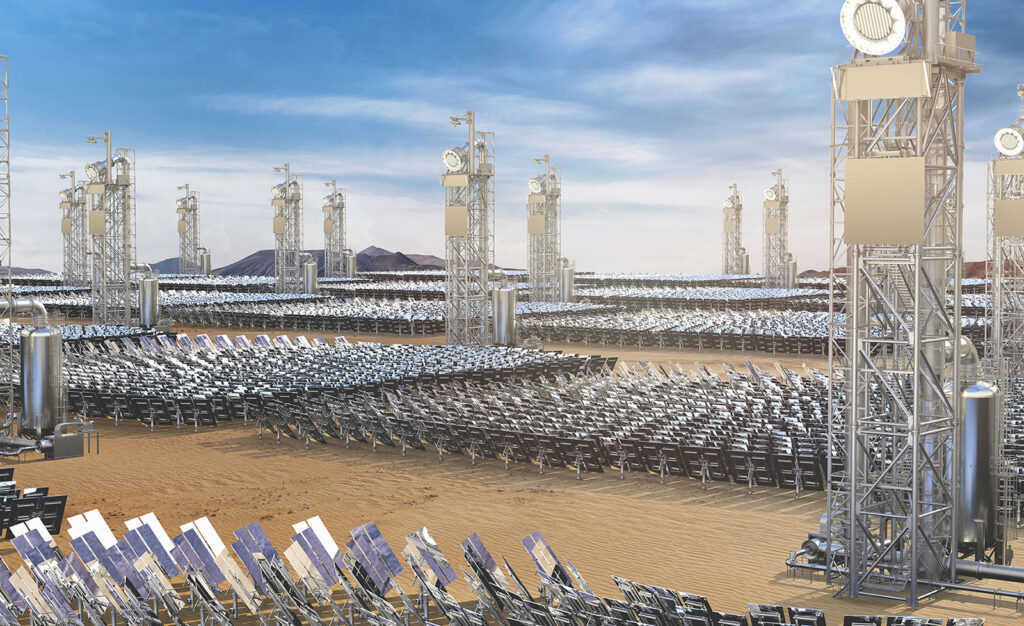
247Solar Plants™ bridge the gap between conventional wind and solar and the need for round-the-clock utility power and industrial-grade heat. 247Solar Plants store the sun’s energy as heat instead of electricity, for 18 hours or more, at much less than the cost of batteries. No generators are required, and 247Solar’s turbines can also burn a variety of fuels, including hydrogen, to ensure 24/7/365 dispatchability.
Extensive Applications
On-grid or off-grid, 247Solar Plants offer a 24/7 alternative to fossil fuels for a broad range of applications:
- Industrial CHP: 24/7 low-carbon Combined Heat & Power for industry
- Data Centers: 247Solar’s hybrid clean solutions are ready to power your data centers as soon as you can build them. 247Solar’s solutions provide both electricity and chilling in a single turnkey package.
- Ultra Heat: Each 247Solar Plant can provide up to 1,500,000 Btu/hr. of heat at temperatures up 1000℃/1800℉ for industrial processes such as cement, glass, steel making, or minerals processing
- Microgrids: Always-on, emissions-free electricity and heat for islands, mines, communities, facilities
- 24/7 baseload power: 24/7 solar electricity, especially for emerging economies
- Green Hydrogen: 24/7 solar electricity and heat to power electrolysis around the clock
- Green Desalination: 24/7 solar electricity and heat to purify water around the clock
MARKET FORCES TRUMP POLITICS AND PLEDGES AS BANKS SHIFT FROM FOSSIL FUELS

TippaPatt/Shutterstock
Wall Street’s biggest banks are rapidly reducing their exposure to fossil fuels, with market-driven pressures overpowering both political headwinds and public climate pledges. According to Bloomberg reporting, financing from the six leading US banks for oil, gas, and coal projects fell by 25% to $73 billion for the year through August 1, 2025, compared to the same period in 2024. The most dramatic decline came from Morgan Stanley, which cut fossil fuel lending by 54%, while Wells Fargo and JPMorgan Chase posted declines of 17% and 7% respectively.
Despite the perception that recent Wall Street exits from the Net Zero Banking Alliance were simple political reactions—especially after Trump’s reelection—actual lending trends reveal that economic fundamentals are steering bank strategy far more than political or ESG rhetoric. Oil and gas market volatility, thinning inventories, and rising asset valuations have increased risk for fossil investments and eroded their appeal. Upstream investment and M&A activity have also plummeted, with global transaction values dropping by 34% in H1 2025, as competitive bidding dried up and bid-ask spreads widened, especially in the US shale sector.
According to industry analysts quoted by Bloomberg, the pullback is a sign that “market risk, not emissions targets, is driving strategy.” Banks are increasingly passive, opting to reduce exposure to unpredictable hydrocarbons while seeking more scalable, compliant, and return-predictable alternatives in clean energy. Private equity and infrastructure funds, meanwhile, are pouring capital into renewables, with dedicated funds for clean technologies raising $134 billion in the first half of 2025 alone—outpacing allocations from the previous year and shifting the investment landscape.
Political rhetoric vs. real investment
The banking sector’s sharp retreat from fossil fuels comes despite noisy rollbacks of public climate commitments and the suspension of global climate alliances in August 2025. While banks have been publicly distancing themselves from net-zero obligations amid politicized backlash, especially in the US, the realignment of capital shows the sector is responding more to economic realities than to regulatory desire.
The outcome is clear: banks are redirecting capital in favor of opportunities aligned with technological maturity, regulatory coherence, and predictable returns. Despite the urgent need for further acceleration—a recent IEA analysis says the current clean-to-fossil investment ratio is still well below the 4:1 needed for a 1.5ºC pathway—the shift underway confirms market forces as the decisive driver. In this new landscape, fossil fuel dealmaking is shrinking not because of politics or green pledges, but because banks are following the money—and the money increasingly favors a future beyond oil and gas.
Read more.
UN: THE ENERGY TRANSITION IS UNSTOPPABLE

United Nations
As reported by CarbonCredits.com, UN Secretary-General António Guterres has declared that the global energy transition has reached a point of no return. In a special address at UN Headquarters in New York, Mr. Guterres cited surging clean energy investment and plunging solar and wind costs that now outcompete fossil fuels. As clean energy investments pass $2 trillion in 2024, renewable energy is now more cost-competitive than fossil fuels. Guterres said we have entered the “clean energy age” and must act quickly to build on this progress.
With solar and wind becoming some of the cheapest sources of energy, countries and companies are shifting toward sustainable energy sources at a fast pace. Key points from the address include:
- Point of no return – The world has irreversibly shifted towards renewables, with fossil fuels entering their decline
- Clean energy surge – $2 trillion invested in clean energy last year, $800 billion more than fossil fuels
- Cost revolution – Solar now 41 per cent cheaper and offshore wind 53 per cent cheaper than fossil fuel alternatives.
- Global challenge – Calls on G20 nations to align new national climate plans with the 1.5°C target of the Paris Agreement
- Energy security – Renewables ensure “real energy sovereignty”
- Six opportunity areas – Climate plan ambition, modern grids, sustainable demand, just transition, trade reform, and finance for emerging markets.
Read more.
FOLLOW & JOIN 247Solar
Contact: info@247solar.com