

RENEWABLES OVERTAKE COAL IN MILESTONE FOR CLIMATE PROGRESS
 The year 2025 marks a historic turning point in the battle against climate change. For the first time, renewables have overtaken coal as the world’s largest source of electricity. This represents a profound shift in how societies generate power and serves as a clear signal that the energy transition is accelerating worldwide.
According to a recent analysis by energy think tank Ember, renewables—including wind, solar, and hydropower—now account for over 30% of total global electricity generation, overtaking the previous dominance of coal. As reported by the BBC, “For the first time ever, wind, solar, and hydropower combined are generating more electricity than coal plants worldwide.” This shift shows that clean technologies are no longer niche but are powering entire economies and offering a credible path away from fossil dependency.
Key Drivers
Several forces have converged to accelerate the rise of renewables. Falling technology costs, improving grid integration, supportive government policies, and mounting public demand for climate action have all played crucial roles. At the same time, innovations in solar and wind turbine design, along with the expansion of battery storage, have made renewables more reliable and cost-competitive.
This means that building new wind or solar farms is now cheaper than investing in new coal plants in much of the world. Fossil fuel divestment campaigns and carbon pricing mechanisms in developed nations further reinforce the financial risks of coal, while the plummeting cost of renewables unlocks clean energy pathways for developed and developing economies alike.
A Turning Point
Ember calls this moment a “crucial turning point”. The BBC quotes Ember senior analyst Malgorzata Wiatros-Motyka as saying it “marks the beginning of a shift where clean power is keeping pace with demand growth”.
The BBC cites specific, encouraging findings:
- solar power delivered the lion’s share of growth, meeting 83% of the increase in electricity demand. It has now been the largest source of new electricity globally for three years in a row.
- Most solar generation (58%) is now in lower-income countries, many of which have seen explosive growth in recent years.
- Solar has seen prices fall a staggering 99.9% since 1975.
Ember notes that solar is now so cheap that large markets for solar can emerge in a country in the space of a single year, especially in developing regions where grid electricity is expensive and unreliable.
As discussed in the following article, China is a major contributor. Ember reports that in August 2025, its clean tech exports hit a record $20bn, driven by surging sales of electric vehicles (up 26%) and batteries (up 23%). Together, China’s electric vehicles and batteries are now worth more than twice the value of its huge solar panel exports.
Diverging Trends
Unfortunately, Ember also points out that while China is making clean technologies ever more accessible and developing countries are rapidly embracing them, richer nations, including the US and EU, are relying more than before on fossil fuels
Per the BBC, in the US, electricity demand grew faster than clean energy output, increasing reliance on fossil fuels, while in the EU, months of weak wind and hydropower performance led to a rise in coal and gas generation. Moreover, even as China’s clean tech exports surge, the US is hindering clean technologies while encouraging the world buy more of its oil and gas.
Still, the surpassing of coal by renewables generates hope for the fight against climate change. Every gigawatt of renewable capacity added means less reliance on high-emission sources and fewer tons of CO₂ released into the atmosphere. As Ember’s states: “This tipping point in global energy generation is one of the surest signs yet that the world can collectively move toward climate goals if nations sustain and build upon this momentum”.
Read more.
ROUND-THE-CLOCK CLEAN CLEAN ELECTRICITY AND HEAT
400kWe 247Solar Plants deployed at scale
247Solar Plants™ bridge the gap between conventional wind and solar and the need for round-the-clock utility power and industrial-grade heat. 247Solar Plants store the sun’s energy as heat instead of electricity, for 18 hours or more, at much less than the cost of batteries. No generators are required, and 247Solar’s turbines can also burn a variety of fuels, including hydrogen, to ensure 24/7/365 dispatchability.
Extensive Applications
On-grid or off-grid, 247Solar Plants offer a 24/7 alternative to fossil fuels for a broad range of applications:
- Industrial CHP: 24/7 low-carbon Combined Heat & Power for industry
- Data Centers: 247Solar’s hybrid clean solutions are ready to power your data centers as soon as you can build them. 247Solar’s solutions provide both electricity and chilling in a single turnkey package.
- Ultra Heat: Each 247Solar Plant can provide up to 1,500,000 Btu/hr. of heat at temperatures up 1000℃/1800℉ for industrial processes such as cement, glass, steel making, or minerals processing
- Microgrids: Always-on, emissions-free electricity and heat for islands, mines, communities, facilities
- 24/7 baseload power: 24/7 solar electricity, especially for emerging economies
- Green Hydrogen: 24/7 solar electricity and heat to power electrolysis around the clock
- Green Desalination: 24/7 solar electricity and heat to purify water around the clock

HOW CHINA’S CLEAN ENERGY LEADERSHIP BENEFITS THE WORLD
Jenson-Shutterstock
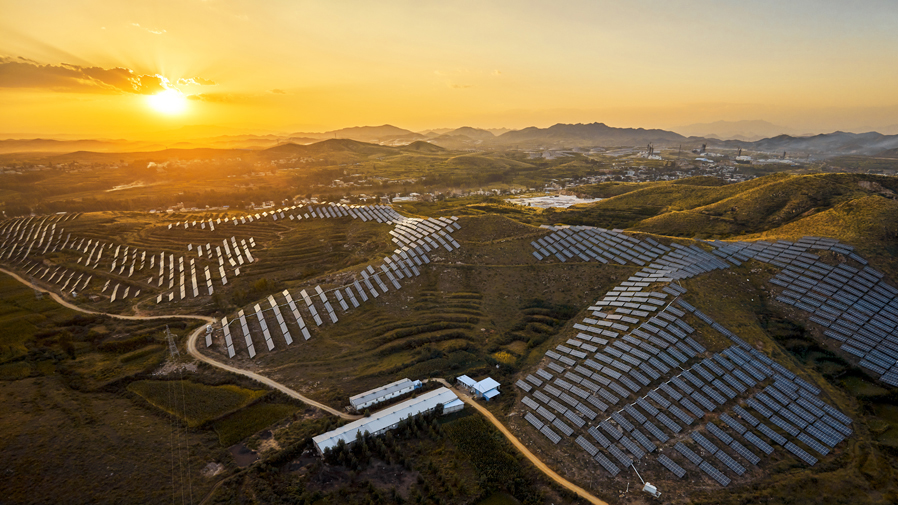
China’s meteoric rise as the global leader in clean energy technology over the past decade is transforming not only its domestic landscape but also the global market and the geopolitics of the energy transition. With its technological prowess, scale, and policy ambition, China is reducing its own emissions footprint while also catalyzing renewable adoption around the world, especially in developing economies.
A special report in The Economist notes that China has produced what it calls a “revolution in global clean energy markets,” noting: “China’s commitment to clean technologies—solar, wind, batteries, and electric vehicles—has bent the cost curve downward, making renewables not just greener but also cheaper for the world.”
Decades of government-driven industrial policy, combined with aggressive investment in research, manufacturing, and infrastructure has led to a position of dominance. The Economist reports that as of 2025, China produces over 80% of the world’s solar panels and a majority of its batteries and wind turbines. This enables it to leverage mammoth economies of scale to drive down costs for domestic and foreign markets alike.
Benefits for the developing world
This reduction in clean technology costs is arguably the most significant benefit to emerging and developing economies. According to a 2025 analysis from Ember, global solar module prices have fallen by over 75% in the last decade, primarily because of China’s mass manufacturing. This affordability allows low- and middle-income countries to leapfrog fossil fuel dependency, expanding electrification and enabling sustainable development.
As The Economist notes, “The proliferation of affordable Chinese solar panels has brought electricity—often for the first time—to remote villages from India to Nigeria.” Such access has knock-on effects on education, health, and local economies, powering schools, clinics, and micro-enterprises that transform lives.
For developing countries, especially in Africa, South Asia, and Latin America, the impact is profound. These nations often face capital constraints, aging grids, and rising energy demand. Cheaper Chinese-made technologies mean they can expand clean power generation with smaller public budgets, reducing both their emissions intensity and exposure to volatile global fossil fuel prices.
The Economist writes, “In the global South, Chinese investment and trade in clean tech are driving electrification and creating green jobs.” Chinese firms now finance, build, and supply projects from Ethiopia’s massive solar parks to Brazil’s growing wind sector, exporting not only technology but also know-how, often at terms better suited to local conditions than those offered by Western firms.
Driving the global energy transition
While China’s economy clearly benefits from its dominance in clean tech manufacturing, perhaps its biggest dividend is the acceleration of the global energy transition. Falling costs for renewables make it possible for the world to shift away from fossil fuels faster than anyone anticipated a decade ago. The International Energy Agency and multiple reports in 2025 suggest that more countries can now deploy gigawatts of solar and wind for less capital outlay than investing in new coal or gas plants.
As the BBC writes, referencing global energy data: “For the first time, renewables have overtaken coal as the world’s biggest single source of electricity, a feat that would have been unimaginable ten years ago without China’s manufacturing muscle and policy leadership.”
Read more.
“REAL ECONOMY” DRIVES ENERGY TRANSITION DESPITE HEADWINDS
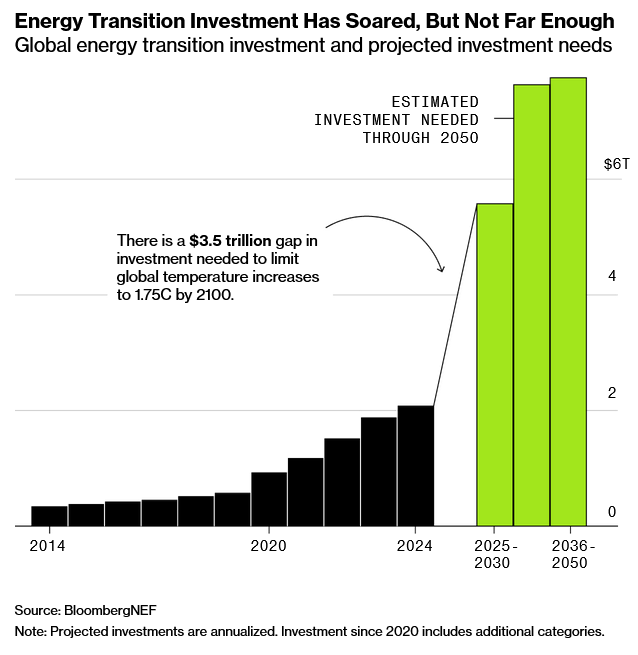 Despite nations repeatedly missing their climate decarbonization goals—including the ambitious 1.5C target set by the Paris Agreement—massive, continuing investment in clean technologies is reshaping the landscape and propelling the energy transition forward.
Bloomberg Green reports that Between 2014 and 2024, global investment in green transition technologies exceeded $10 trillion. Notably, annual energy transition investment surged past $2 trillion for the first time in 2024, more than doubling since 2020. Bloomberg says this influx of capital is “offering promise that progress can still rapidly accelerate” even as political setbacks and missed deadlines threaten to slow global progress.
Although dozens of major nations failed to meet the latest emissions strategy deadlines and even the most optimistic forecasts now concede that limiting planetary warming to 1.5C is “out of reach,” the ongoing flow of investment in technologies such as renewables, electric vehicles, nuclear power, and methane reduction measures continues to advance. Sectors from energy and transport to agriculture are seeing “changes to less polluting processes,” with clean power generation additions, such as solar and wind, finally beginning to catch up with demand.
A BloombergNEF analysis goes so far as to suggest the world may have already reached peak energy sector carbon emissions, with the possibility of decline going forward, although this could be challenged by stronger-than-anticipated fossil fuel demand.
Bloomberg contends the data suggests that exponential increases in technology deployment and efficiency are leading political and economic will, allowing “the real economy” to drive the transition even when global negotiations and diplomacy struggle.
Thus, record-breaking investment in clean technologies is offsetting shortfalls in formal climate goals and government action. This dynamic market-driven progress provides optimism for the energy transition and global decarbonization, with the “real economy” decisively moving forward.
Read more.
FOLLOW & JOIN 247Solar
Contact: info@247solar.com